

1. Overview
AI infrastructure is generating massive computing demand. As artificial intelligence enters a phase of hyper-growth, chips have become the gold rush of this era: the global AI computing market is expanding rapidly, the AI chip market is scaling in tandem, and chip design is shifting decisively toward scenario-specific customization. This article summarizes the market signals behind that shift along three dimensions — AI computing, AI chips, and custom silicon.
2. Global AI Computing Demand Is Surging
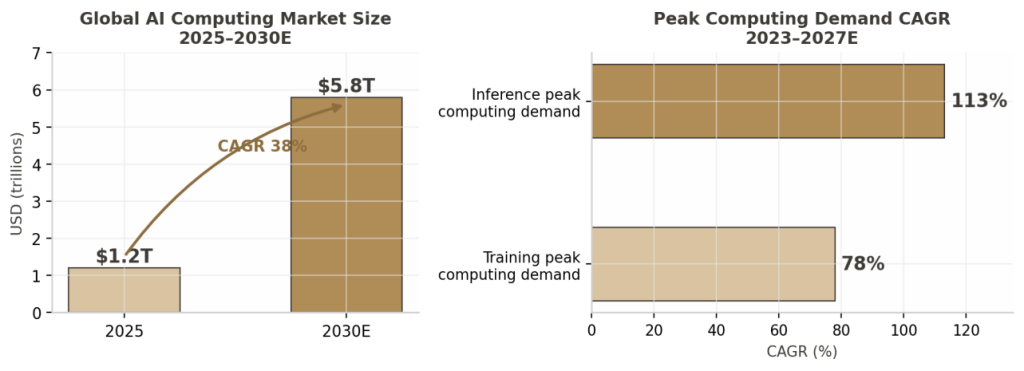
The global AI computing market is on a steep growth trajectory. The market is projected to expand from $1.2 trillion in 2025 to $5.8 trillion in 2030, representing a compound annual growth rate (CAGR) of 38% over the period.
Demand is accelerating on both the training and inference sides, with inference growing markedly faster. Training peak computing demand is expected to grow at a CAGR of 78% from 2023 to 2027, while inference peak computing demand is projected to grow at a CAGR of 113% over the same period — a clear sign that the center of gravity in AI computing is shifting from model training toward large-scale inference deployment.
Table 1. Key indicators of the global AI computing market.
| Indicator | Value | Period |
|---|---|---|
| Global AI computing market size | $1.2T → $5.8T | 2025–2030E (CAGR 38%) |
| Training peak computing demand CAGR | 78% | 2023–2027E |
| Inference peak computing demand CAGR | 113% | 2023–2027E |
3. AI Chip Market Growth
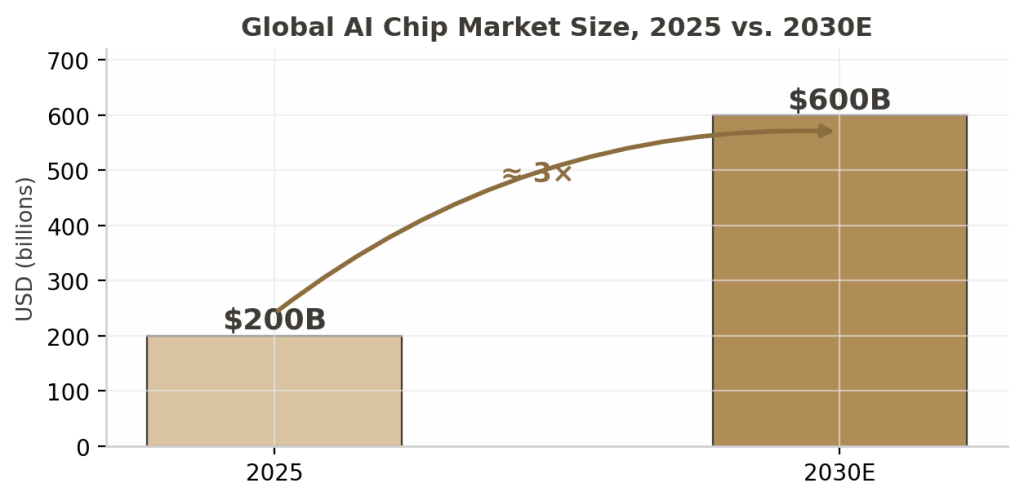
Rising computing demand is pulling the AI chip market upward in tandem. The global AI chip market is projected to grow from $200 billion in 2025 to $600 billion in 2030 — roughly a threefold expansion in five years. AI chips are becoming the core carrier of AI infrastructure, with demand entering a phase of rapid expansion.
4. The Customization Trend: Custom Silicon
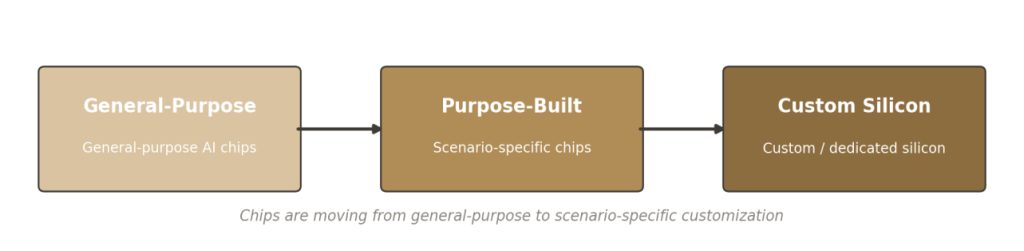
Beneath the market expansion, chips are moving from general-purpose designs toward scenario-specific customization. The industry is progressing along a clear path: from general-purpose AI chips, to purpose-built chips tailored to specific scenarios, and ultimately to custom silicon designed for dedicated workloads.
This customization trend is equally visible in the deep integration of computing with other capabilities. Rather than standing alone, compute is increasingly fused with inference, networking, and storage to form tightly integrated solutions:
Table 2. Integration directions in custom silicon.
| Integration Direction | Description |
|---|---|
| Compute × Inference | Integrated compute and inference |
| Compute × Network | Integrated compute and networking |
| Compute × Storage | Integrated compute and storage |
5. Conclusion
The logic of the gold rush is straightforward: surging AI computing demand is expanding the AI chip market, and market expansion in turn is accelerating the shift toward custom silicon. As AI infrastructure continues to generate massive computing demand, chips — increasingly purpose-built and custom-designed — will remain the core carrier of the AI era.