

1. Introduction
In 2026, with OpenClaw breaking into the mainstream and the GTC conference drawing to a close, the AI industry is approaching an inflection point. A paradigm revolution comparable to the Transformer could erupt at any moment, bringing new changes to the industry landscape. As a high-performance server CPU company focused on AI computing and cloud computing, Yuxian keeps a constant eye on industry developments and technology trends. Drawing on industry observation and technical understanding, this article examines, from an industry perspective, the new mission that server CPUs will undertake in the agent era. It is intended to spark discussion, and we look forward to exploring these questions together with colleagues across the industry.
In earlier waves of AI computing, server CPUs mainly performed basic work such as task scheduling and data movement. As the industry deepens and evolves, however, server CPUs are embracing new long-term development opportunities in this round of AI, realizing a major shift in industry logic along two main directions:
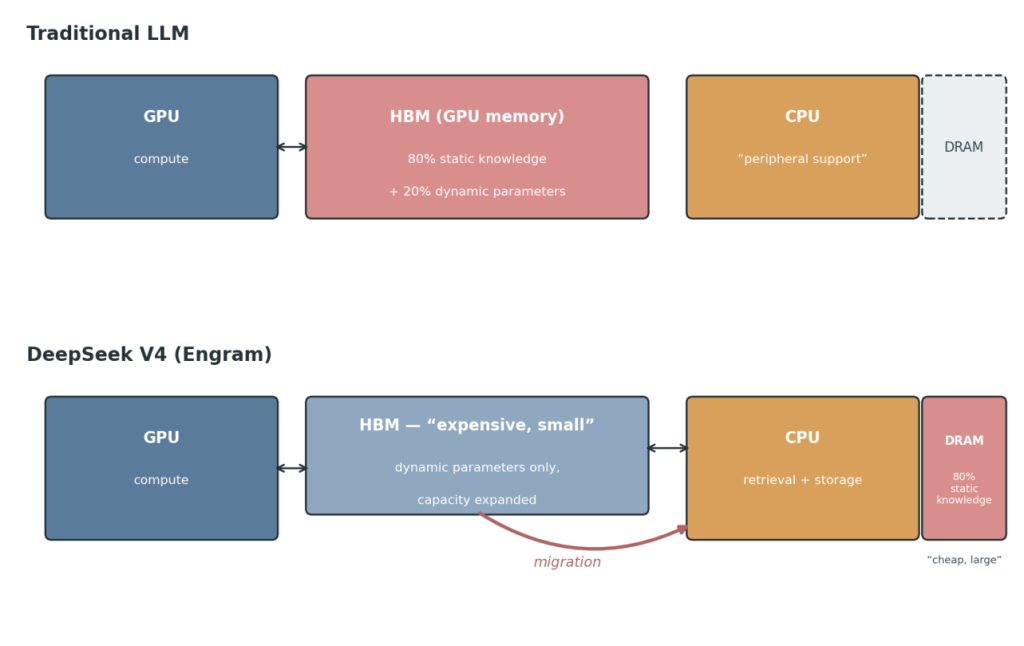
(1) AI inference. Traditional large models rely on GPUs to store and retrieve massive amounts of knowledge. Roughly 80% of that knowledge is static, occupying large amounts of GPU memory, squeezing out the room GPUs have for deep inference and driving up AI deployment costs. A new generation of domestic Chinese large models transfers static knowledge from GPU memory into CPU memory, freeing GPU compute to focus on dynamic inference, improving model performance, and allowing models of the same or even larger capacity to be deployed with far fewer GPUs than before — democratizing AI deployment from the very source of hardware cost.
(2) AI agents. AI is accelerating its evolution toward agents, which must handle large volumes of control-intensive tasks that depend heavily on CPUs, and must create sandbox environments on CPUs in which agents can execute tasks in a closed loop. Agents therefore set higher requirements for the CPU’s role, quantity, and performance in AI — and the impact of agents on CPU demand is not linear, but multiplicative or even exponential.
2. AI Inference: An Architectural Revolution from “GPU Monopoly” to “CPU–GPU Collaboration”
On January 13, 2026, DeepSeek published a new paper, Conditional Memory via Scalable Lookup: A New Axis of Sparsity for Large Language Models. The paper proposes a brand-new Engram module that moves static knowledge — which accounts for 80% of a model’s parameter capacity — from GPU memory into CPU memory. This architectural innovation not only improves model performance on multiple standard benchmarks by redefining the role of the CPU, but also greatly reduces AI computing costs. This change will be an indispensable modeling component of next-generation models.
2.1 The CPU Becomes the Storage and Retrieval Hub for Static Knowledge
In traditional large-model architectures, the CPU undertakes only basic work such as data transfer and task scheduling, while core knowledge storage and inference computation are handled entirely by the GPU, leaving CPU compute and memory resources severely idle. Through the Engram module, DeepSeek V4 redefines the role of the CPU, turning it into the storage and retrieval hub for static knowledge while activating the CPU’s natural advantages in large-scale data storage and efficient retrieval.
(1) The dilemma of existing large models
Existing Transformers lack a native knowledge lookup mechanism and are forced to simulate retrieval inefficiently through computation. Specifically, when an existing model recognizes an entity, it must consume multiple layers of attention and feed-forward networks, piecing together features layer by layer before it can finally identify the semantics correctly. The paper cites a concrete case, “Diana, Princess of Wales”: the model needs six layers to complete the recognition process. The first few layers are still wrestling with intermediate states such as “Wales is a region of the United Kingdom” and “Princess of Wales is a kind of title,” before finally “recalling” that this refers to Princess Diana.
Table 1. GPU compute is consumed by shallow-layer “search”: layer-by-layer recognition of “Diana, Princess of Wales.”
| Layer | Latent State Translation | Explanation |
|---|---|---|
| 1–2 | :Country in the United Kingdom | Wales |
| 3 | :Country in Europe | Wales |
| 4 | :Title held by female sovereigns in their own right or by queens consort | Princess of Wales (unspecific) |
| 5 | :Title given to the wife of the Prince of Wales (and later King) | Princess of Wales (unspecific) |
| 6 | :Diana, Princess of Wales (1961–1997), the first wife of Prince Charles, Prince of Wales, who was famous for her beauty and humanitarian work | Diana, Princess of Wales |
This mode of computation has two main limitations:
1) It essentially rebuilds a static lookup table. Not only is “computing” the answer slow and inefficient for this purpose, but deep network capacity that could have been used for higher-level reasoning is wasted on the relatively “cheap” work of recognizing concepts, crowding out room for deep inference.
2) Large models contain large amounts of “static knowledge,” which resembles a read-only encyclopedia: at inference time it is mainly “consulted” rather than participating in complex dynamic computation. In traditional models, static knowledge is stored in GPU memory, where it also occupies the memory space available to the dynamic computation model, limiting further improvement in model capability.
(2) The architectural innovation
Large models contain large amounts of static knowledge that can be peeled away — knowledge that is mainly “looked up” at inference time rather than participating in complex dynamic computation — and separating it from the GPU onto the CPU can bring enormous optimization gains. The DeepSeek team inserts an Engram module between the original Transformer layers; the module resides in CPU memory rather than GPU memory. The Engram module can be understood as a huge, scalable embedding table dedicated to storing static knowledge — typically high-frequency entities, fixed patterns, or common sense — that at inference time needs to be read directly by the CPU rather than computed by the GPU. With the same example, “Diana, Princess of Wales,” the model can directly find the correct interpretation of “Diana” by looking up the Engram module in the CPU, instead of reasoning over the entire sentence.
As a result, the massive parameters of static knowledge are transferred from GPU memory (HBM) into CPU DRAM. The GPU memory previously occupied by static knowledge is released and can be used to load a larger dynamic computation model — for example, more complex MoE (Mixture-of-Experts) experts or deeper network layers — thereby directly raising the ceiling of model capability.
2.2 A Substantial Reduction in AI Deployment Costs
Traditional hundred-billion-parameter large models rely on multiple GPUs essentially because they need high-capacity GPU memory to carry massive static knowledge. As model parameters keep growing, HBM capacity has become a significant bottleneck constraining model scaling, and continually expanding HBM capacity greatly increases AI deployment costs.
Through the Engram architectural innovation, DeepSeek V4 can offload a hundred-billion-parameter Engram table from GPU memory directly into “CPU memory (DRAM),” which is cheap, capacious, and easy to scale. DeepSeek’s measured data show that even with a 100B-parameter Engram table mounted in CPU memory, throughput drops by less than 3% compared with pure-GPU inference. In addition, the CPU can work in tandem with SSD storage, further reducing the occupancy pressure on high-frequency memory and forming a tiered “CPU memory + SSD” storage system — democratizing AI deployment from the very source of hardware cost.
The CPU’s core application in DeepSeek V4 is therefore breaking the AI industry’s absolute dependence on GPUs, and it is highly likely to reshape the competitive landscape of the entire AI infrastructure.
Role: the CPU’s role in large models shifts from “peripheral support” to “storage and retrieval.” It plays an increasingly important part, and it also sets higher performance requirements for the CPU.
Cost: CPU memory can likewise support large-model operation, at a cost of only one-tenth that of a pure-GPU solution.
Deployment: the CPU’s generality frees AI infrastructure from being bound to “high-end GPUs”; ordinary servers can also become AI deployment nodes, lowering the barrier to AI adoption.
3. AI Agents: The CPU’s Core Compute Leap from “Porter” to “Steward”
The rapid development of AI agents is driving the rising importance — and surging demand — of server CPUs as a core compute engine. According to Gartner forecasts, 40% of enterprise applications will embed task-based AI agents in 2026, up from less than 5% in 2025. The agent boom marks a paradigm shift in AI from “content generation” to “task execution.” This shift is not simple linear growth; it places entirely new demands on the structure of compute. The core logic is this: an agent’s operating mechanism relies heavily on complex logical orchestration and independent sandbox environments, both of which are CPU-intensive tasks rather than the parallel computing tasks at which GPUs excel. This structural change is causing server CPU demand to surge.
3.1 The CPU Becomes the Primary Performance Bottleneck of Agent Systems
Unlike traditional chatbots, an agent system’s working path depends heavily on the CPU. Although AI has undergone explosive development, its main form today is still the chatbot (LLM), whose working path is a single pass of “user input – inference – output,” with the main bottlenecks in GPU compute and memory. To “execute tasks,” an AI agent adds a decision-making orchestrator and external tools on top of the LLM, and its working path becomes a loop of “input – inference – tool invocation – reflection – inference again.” Logical judgment tasks such as task scheduling, state-machine control, context management, and tool dispatch are highly sequential with complex logical branches — typical control-plane workloads. Such tasks place extremely high demands on single-core latency, branch-prediction accuracy, and context-switching efficiency, making them better suited to high-performance CPU cores.
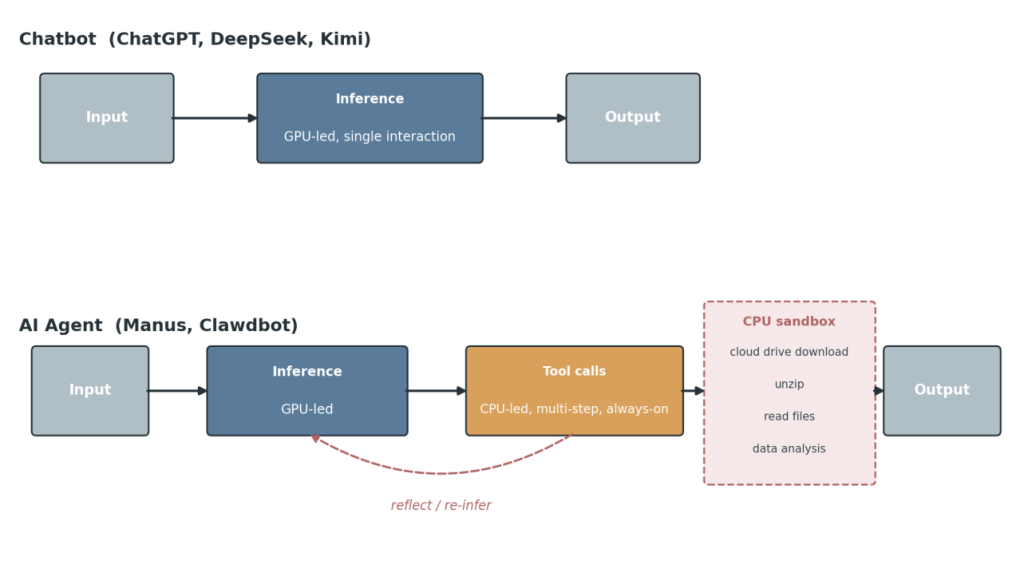
In the agent era, the CPU becomes a significant bottleneck. Because AI agents introduce large numbers of external tools (such as web search, Python interpreters, and retrieval databases) that mainly run on the CPU, the CPU becomes a critical bottleneck for performance, throughput, and energy consumption. In a paper jointly published in November 2025 by researchers at the Georgia Institute of Technology and Intel Labs, five representative agent workloads were experimentally measured for end-to-end runtime across multiple benchmarks. According to the paper, across all settings the dominant contribution to latency came mostly from tool processing running on the CPU — retrieval, the WolframAlpha API, literature search, LexRank summarization, and Bash/Python execution — accounting for 84.5%–90.6% of end-to-end latency.
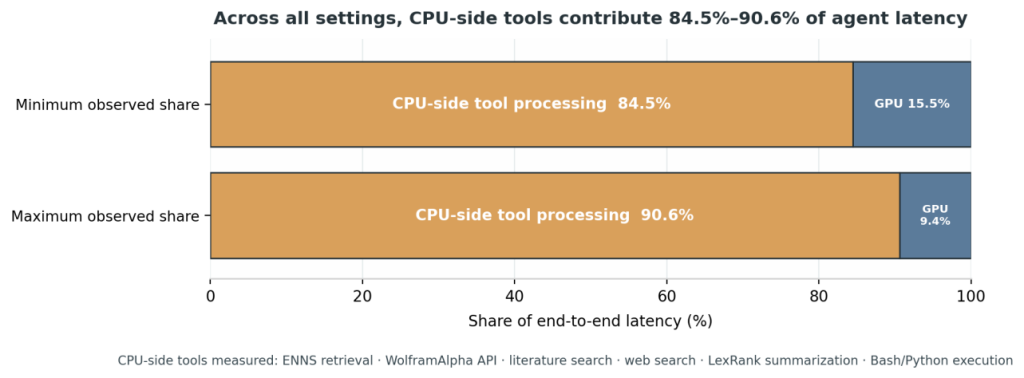
To sum up: in the chatbot era, the CPU was a “porter,” merely carrying and forwarding user instructions, and was relatively unimportant. In the agent era, the CPU is a “steward,” coordinating the agent’s operating environment, multi-agent invocation, and memory-system management — undertaking the core computing work.
3.2 Agent Sandbox Environments Drive Demand for Both CPU Quality and Quantity
The new generation of AI agents differs significantly from traditional agents in operating mechanism, execution environment, and resource requirements. Their closed-loop execution of complex tasks greatly increases demand for independent sandbox environments and for high-performance, high-concurrency CPUs, and the CPU’s role and share of time across the entire task flow increase markedly. Traditional agents only perform intent recognition, and execution relies on simple API calls. New-generation agents, by contrast, must create a “sandbox environment” in the cloud in order to execute tasks safely and in a closed loop (such as writing code, processing files, and analyzing data). These sandboxes essentially simulate a complete computer: the agent runs Python code, unzips files, renders web pages, and so on inside them, relying on the CPU’s general-purpose computing power. The two kinds of agents differ as follows:
API-call agents (no sandbox needed). Typical scenarios: food delivery, e-commerce shopping, and hotel booking. The agent acts only as a “dispatcher” and “translator”: after understanding the user’s intent, it directly calls ready-made underlying APIs. There is no need to create an independent virtual sandbox environment; the existing business servers (such as the food-delivery platform’s servers) are reused directly.
Sandbox agents. Typical scenarios: complex file processing (cloud-drive download → unzip → data analysis), slide-deck creation (for which there is no standard API), and general productivity work. The task involves file operations, rendering, or complex non-standardized steps, so there must be an independent “operating space” to carry these actions. An independent virtual environment (sandbox) must be created for every task, consuming additional CPU and memory.
In terms of demand, a simple agent task may require creating one or two sandbox environments, and each user may trigger dozens of sandboxes simultaneously. Although a single task may be allocated only 0.5 cores and 1 GB of memory, demand grows exponentially under massive concurrency. Moreover, the CPUs used for agent sandbox execution do not have to be packaged in the same AI server as the GPUs — they can be independent, general-purpose server CPUs. This means that agent-driven CPU demand is not strongly bound to GPU counts and follows its own independent growth logic.
Beyond the quantity of CPUs, in scenarios of high-concurrency tool invocation and complex sandbox execution, CPU performance directly determines an agent’s response speed and success rate — which likewise calls for higher-performance CPUs.
Table 2. Traditional chatbot vs. AI agent.
| Dimension | Traditional Chatbot | AI Agent | Change |
|---|---|---|---|
| Interaction mode | One question, one answer; done after use | Self-directed task decomposition, multi-step execution, always online | Time online increases substantially |
| Token consumption | ~2k tokens per interaction | 10k–20k tokens at launch; 200k–1M+ tokens for deep tasks | 100×–1,000× |
| Concurrency ratio | Extremely low (~1%) | Extremely high (30–40% or more) | 30–40× |
| Latency bottleneck | Mainly GPU inference | CPU processing accounts for up to 90.6% of end-to-end latency | The CPU becomes the primary bottleneck |
| Compute type | GPU-dominated | CPU (logic / sandbox) + GPU inference | CPU importance rises significantly |
As task chains grow longer (long-context / long-horizon reasoning), the CPU’s share of working time will increase substantially. Unlike a traditional conversation, an agent’s completion of a task (such as writing a report) is a process in which the CPU and GPU alternate and cooperate:
Step 1 (GPU-led): the user issues an instruction; the GPU performs inference and generates a detailed to-do list (task planning and decomposition). Once planning is complete, the GPU pauses.
Step 2 (CPU-led): the CPU starts doing the heavy lifting according to the to-do list — controlling the browser, searching the web, downloading files, and looking for information.
Step 3 (GPU steps in): after the CPU completes a subtask, the GPU steps in to score and evaluate the completion (review). If the evaluation fails, the CPU keeps working; if it passes, the process moves on to the next subtask.
Step 4 (GPU wraps up): after all tasks are complete, the GPU produces the final summary and report.
The CPU shoulders the long execution process in between. The longer the chain of thought and execution (that is, the more complex the task), the higher the CPU’s share of runtime in the whole process.
4. Conclusion: Evolving AI Compute Demand Drives CPU Design Evolution
Looking back at the evolution of AI compute, every architectural leap has redefined the core of computing. From the rise of the GPU to today’s powerful return and evolution of the CPU’s role — this is not replacement, but a deeper fusion: a new compute revolution in which CPUs and GPUs cooperate efficiently, each playing to its strengths, is now unfolding in full.
In the surging era of AI agents, the value of high-performance server CPUs is irreplaceable and their potential boundless. As an innovator focused on high-performance server CPUs, Yuxian insists on making all-out breakthroughs around AI scenarios — pursuing stronger performance, lower cost, and easier deployment — and continues to build domestically produced high-performance server CPU solutions, laying a solid and agile computing foundation for China’s AI industry.
The tide of transformation is upon us, and the industry landscape is being reshaped. Yuxian looks forward to standing shoulder to shoulder with all ecosystem partners, embracing together the opening chapter of this industry restructuring, and jointly ushering in a new era of the intelligent future.
About Yuxian Microelectronics
Yuxian Microelectronics is a domestic Chinese high-performance server CPU company focused on AI computing and cloud computing. Its products include server CPUs, AI servers, general-purpose servers, and software services. Its products and services meet leading domestic and world-class international standards, covering application fields such as the Internet, finance, telecommunications, and energy.
The company continuously builds a cooperative, win-win industrial ecosystem and is committed to injecting strong momentum into China’s domestically produced AI computing technology system and the high-quality development of the artificial-intelligence economy — striving to produce top-tier domestic large-chip products and R&D services.
Sources
- DeepSeek, “Conditional Memory via Scalable Lookup: A New Axis of Sparsity for Large Language Models,” January 13, 2026.
- Gartner forecast, as cited in the original article.
- Georgia Institute of Technology and Intel Labs, “A CPU-Centric Perspective on Agentic AI,” November 2025.